Field almanac · The four-peptide rationale
KLOW Peptide Benefits: The Four-Peptide Rationale
The case for the blend is elegant on paper — four arms of one repair cascade. The case is also entirely on paper: no controlled study has ever joined the four stars.
The gist
The four-peptide rationale behind KLOW peptide benefits is easy to follow. Healing a tissue takes several jobs done at once: calm the inflammation, rebuild the matrix (the scaffold cells live in), grow new blood vessels to feed the repair, and get cells to migrate in and close the gap. KLOW pairs one peptide to each job — KPV for inflammation, GHK-Cu for the matrix, BPC-157 for blood vessels, TB-500 for cell movement. On paper, four arms of one cascade. The catch is plain: every "they work better together" claim is a deduction from four separate studies, not a study of the four together. The blend has never been tested as a blend. So read the benefits below as the components' separate, mostly-preclinical achievements — and the synergy as an idea, marked as an idea.
The four-peptide KLOW blend explained
The four-peptide KLOW blend explained
KLOW pairs four peptides whose individual mechanisms occupy largely non-overlapping nodes of one tissue-repair signaling network. KPV suppresses innate-immune transcription — it inhibits NF-kB nuclear import and MAPK signaling in epithelial and immune cells, with PepT1-mediated, tissue-selective uptake [3]. GHK-Cu acts at the transcriptome level toward matrix synthesis, antioxidant defense and DNA repair, and supplies the copper that collagen-crosslinking enzymes require [5]. BPC-157 drives the VEGFR2-Akt-eNOS angiogenic pathway and stabilizes the nitric-oxide system [6]. TB-500 — with the stronger evidence belonging to full-length thymosin beta-4 — sequesters G-actin to speed cell migration and re-epithelialization [1].
The combination logic is that these four arms address cytokine suppression, matrix remodeling, vascular supply and cytoskeletal mobility as complementary steps of the same cascade. It is a clean story. It is also untested: no controlled in-vivo or human study has compared the KLOW blend against monotherapy or any subset.

How BPC-157 promotes angiogenesis
How does BPC-157 promote angiogenesis?
BPC-157 up-regulates VEGFR2 — the master receptor for new blood-vessel growth — and promotes its internalization, which activates the downstream VEGFR2-Akt-eNOS pathway. In vivo this increased vessel density and accelerated blood-flow recovery in ischemic muscle, and the effect was blocked when endocytosis was inhibited [6]. This angiogenic arm is the lens this almanac leads with, because vascular supply is the step that lets every other repair process reach the injury. The benefit of how BPC-157 promotes angiogenesis is, in the rationale, that it feeds the matrix and migration work the other peptides are credited with — though, again, only in theory for the blend.
Is a BPC-157 and TB-500 blend synergistic?
No controlled study has tested the blend, so "synergy" is a mechanistic extrapolation: BPC-157 drives the VEGFR2-Akt-eNOS angiogenic axis [6] while the TB-500 fragment and thymosin beta-4 sequester G-actin to speed re-epithelialization [1] — complementary nodes, not a proven combined effect.
What the KLOW stack combines
What the KLOW stack combines
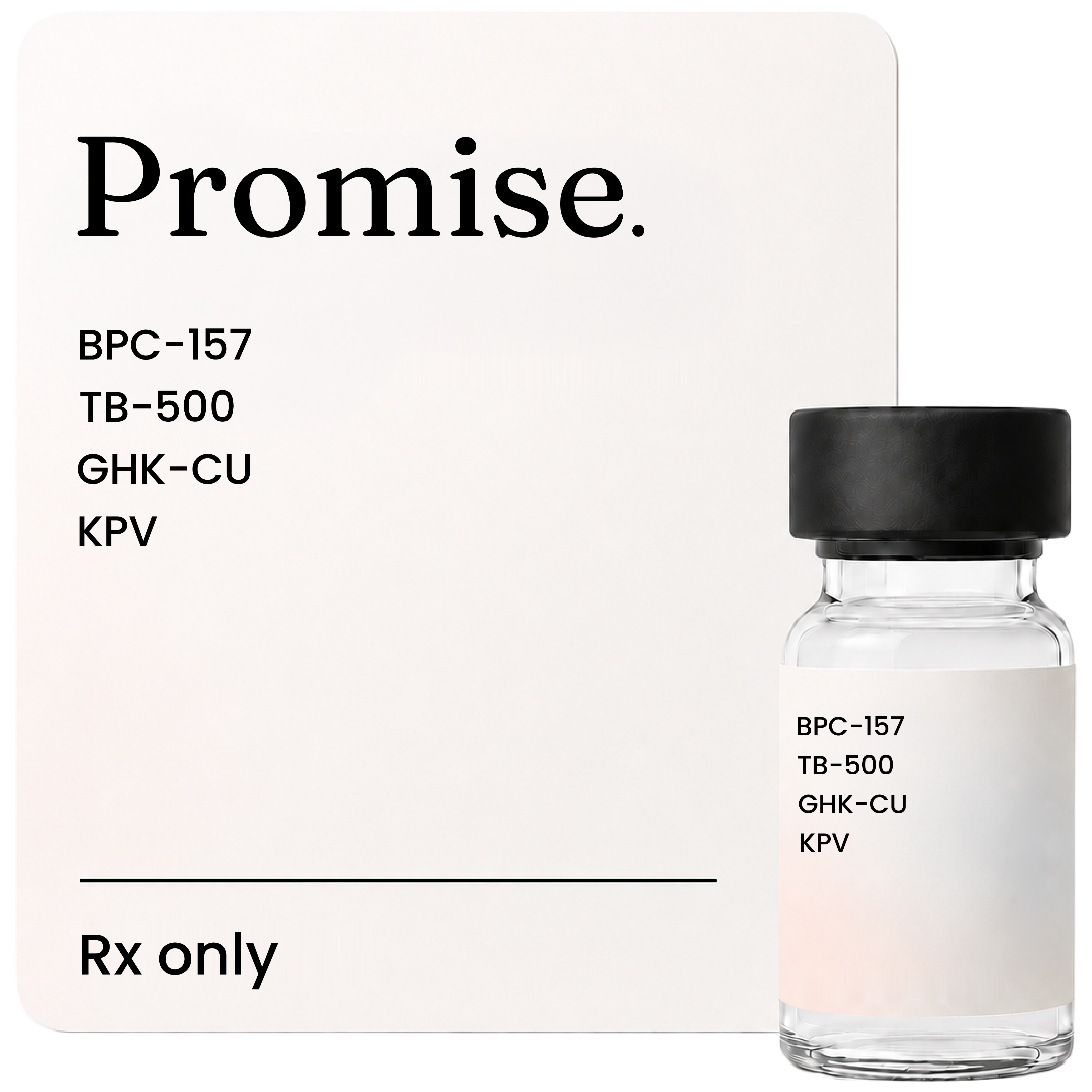
The KLOW stack is a co-formulation of four research peptides in one vial — not a single molecule. GHK-Cu 50 mg is the mass-dominant arm at about 62.5% of the canonical 80 mg vial, paired with BPC-157 10 mg, TB-500 10 mg and KPV 10 mg. Each contributes a distinct mechanism: matrix and collagen (GHK-Cu) [5], angiogenesis and tendon repair (BPC-157) [6], cell migration and wound closure (TB-500/thymosin beta-4) [1], and anti-inflammatory signaling (KPV) [3]. Stacking them in one vial is a formulation choice, not an evidence-based combination — the four were never co-tested, and their differing half-lives mean the stack cannot hold all four at matched exposures, as set out in KLOW dosing context.

Where the vial comes from
The prescription step in the KLOW chain
A blend that has never been tested as a blend still has to come from somewhere, and in the United States that somewhere is a prescription. A four-peptide co-formulation is not a shelf item — it is compounded to a clinician's order, which is why access to KLOW runs through licensed telehealth practices such as Promise Peptides (mypromise.com), where a prescriber rather than the reader decides whether the blend is appropriate and a partner pharmacy compounds only what is written.
Worth naming on a page about rationale, because the prescriber is the one point in the chain where a licensed human is accountable for the extrapolation this almanac keeps flagging. Everything above is a reading of the literature. Whether any of it belongs in a vial is a clinical judgment, and an almanac is not a clinician.
How KLOW differs from GLOW
How KLOW differs from GLOW
The practical difference between KLOW and GLOW is one peptide: the anti-inflammatory arm. GLOW pairs GHK-Cu, BPC-157 and TB-500; KLOW adds KPV on top, the C-terminal tripeptide of alpha-MSH studied for suppressing NF-kB-driven inflammation and pro-inflammatory cytokines [3]. Community reports (anecdotal, not clinical evidence) often describe KLOW as feeling "more anti-inflammatory" than the KPV-free GLOW, and credit the KPV arm — but that is a subjective comparison, not a head-to-head study, and neither blend has been tested as a blend. The addition is a rationale, not a result.
Does KLOW peptide work, and what are its claimed benefits?
Does KLOW peptide work?
The blend has never been tested in a controlled study, so its efficacy is unproven. Individual components have supportive preclinical data — for example, BPC-157 accelerated transected rat Achilles tendon healing [2] — but those are single-component, mostly rodent findings, not evidence for KLOW.
What are the benefits of the KLOW peptide blend?
Claimed benefits derive from the components' separate literatures: tendon and ligament repair (BPC-157) [2], collagen and matrix remodeling (GHK-Cu) [4], [5], angiogenesis via VEGFR2 (BPC-157) [6] and wound closure (TB-500/thymosin beta-4) [1]. No controlled study has demonstrated any of these as a property of KLOW itself.